National PAR Monitor Report: Strategy for PAR 2024/2025 – Montenegro

The assessment of transparency and inclusiveness of the PAR agenda in this report focuses on two critical issues – 1) participatory development of PAR planning documents, that includes non-state actors, and 2) involvement of CSO in the work of the governmental PAR coordination and monitoring mechanisms. For the former, the assessment briefly emphasises basic regulatory requirements for conducting consultations, continuing with the assessment of practices in involving external stakeholders and the public in the different stages of policy development for a sample of 16 PAR planning documents adopted since the PAR Monitor 2021/2022. For the latter, this report examines the extent and methods of CSOs’ and other non-state actors’ involvement in the PAR coordination and monitoring, both at the political and at the administrative levels, highlighting how institutionalised, and how meaningful, any such involvement is in practice. Findings of this report reflect the period since the publication of the PAR Monitor 2021/2022, starting from the second half of 2022, and until the end of 2024.

The National PAR Monitor Report: Strategy for PAR 2024/2025 – Montenegro is available for download here: English and Montenegrin.
National PAR Monitor Report: Strategy for PAR 2024/2025 – Albania

The assessment of transparency and inclusiveness of the PAR agenda in this report focuses on two critical issues – 1) participatory development of PAR planning documents, that includes non-state actors, and 2) involvement of CSO in the work of the governmental PAR coordination and monitoring mechanisms. For the former, the assessment briefly emphasises basic regulatory requirements for conducting consultations, continuing with the assessment of practices in involving external stakeholders and the public in the different stages of policy development for a sample of 16 PAR planning documents adopted since the PAR Monitor 2021/2022. For the latter, this report examines the extent and methods of CSOs’ and other non-state actors’ involvement in the PAR coordination and monitoring, both at the political and at the administrative levels, highlighting how institutionalised, and how meaningful, any such involvement is in practice. Findings of this report reflect the period since the publication of the PAR Monitor 2021/2022, starting from the second half of 2022, and until the end of 2024.

The National PAR Monitor Report: Strategy for PAR 2024/2025 – Albania is available for download here: English and Albanian.

Regional Western Balkan PAR Monitor: Strategy for PAR 2024/2025

The assessment of transparency and inclusiveness of the PAR agenda in this report focuses on two critical issues – 1) participatory development of PAR planning documents, that includes non-state actors, and 2) involvement of CSO in the work of the governmental PAR coordination and monitoring mechanisms. For the former, the assessment briefly emphasises basic regulatory requirements for conducting consultations, continuing with the assessment of practices in involving external stakeholders and the public in the different stages of policy development for a sample of 16 PAR planning documents adopted since the PAR Monitor 2021/2022. For the latter, this report examines the extent and methods of CSOs’ and other non-state actors’ involvement in the PAR coordination and monitoring, both at the political and at the administrative levels, highlighting how institutionalised, and how meaningful, any such involvement is in practice. Findings of this report reflect the period since the publication of the PAR Monitor 2021/2022, starting from the second half of 2022, and until the end of 2024.

The Western Balkan PAR Monitor: Strategy for PAR 2024/2025 is available for download here: English.

Reorganization of the Government


It has been four years since the government reorganization process, which primarily involved reducing the number of ministries, but did not extend to other bodies under their responsibility. This process was a result of an electoral promise and the subsequent agreement between the two parties, VV and LDK, which formed a postelection coalition to establish the government known as the “Government Kurti 1” in February 2020. Originally, there were 21 ministries, but as a result of the political agreement between VV and LDK, it was proposed to reduce the number to 15. However, due to political changes following the formation of the Hoti Government later in the same year, an additional ministry was added, bringing the total to 16 ministries. In 2021, with the formation of the Government Kurti 2, the number of ministries was reduced again to 15. The analysis focuses on several key aspects, including the rationale behind the organizational process, the legal framework, internal structure, classification, and the reorganization of job positions. Each segment is systematically examined, analyzing its impact on the government reorganization process and how it contributes to optimizing its functionality.

The analysis focuses on evaluating the rationale behind the organizational changes, examining how legal and structural aspects contribute to creating a more efficient and functional administration. It will include an in-depth review of the legal framework supporting the reorganization and its impact on the internal structure of the administration.

Download the brief here: ENG |ALB

Law on Senior Civil Service: Is the Government Hesitant to Adopt it?


A professional, impartial, and effective public administration is key to the functioning of every democratic society. Therefore, it is very important to recruit educated and skilled professionals who are selected based on their qualities rather than their political affiliation. Recruitments, promotions, and dismissals of civil servants based on merit encourage candidates to apply for job positions in public administration, knowing that they will go through a transparent selection procedure and be assessed based on their competencies. Simultaneously, it motivates them to be proactive, ambitious, and hard-working, expecting to be rewarded for their work. This is especially important for senior civil servants with greater obligations and responsibilities. Hence, it is even more significant that their selection is merit-based. Their decisions affect the entire institution, which means they must respect the priorities of the government and the citizens they serve, acting in compliance with ethical standards. Such a professional attitude towards work, particularly among senior civil servants, strengthens personal and institutional integrity while increasing responsibility in work and enhancing public trust in institutions.

Download the brief here.

PAR Monitoring and Coordination: From Recommendation to Action – Overcoming Barriers in SAI Recommendation Implementation


In every constitutional democracy, independent institutions play a crucial role in maintaining checks and balances. In Albania, the State Audit Institution (SAI) is the highest supervisory authority for financial and administrative matters within public institutions. It provides recommendations for public institutions, the central government, local authorities, and public companies or joint-stock companies where the state holds a 50%+1 share. SAI also has a clear constitutional mandate to oversee and audit the use of public funds, ensuring they are managed responsibly and transparently.

Download the brief here.

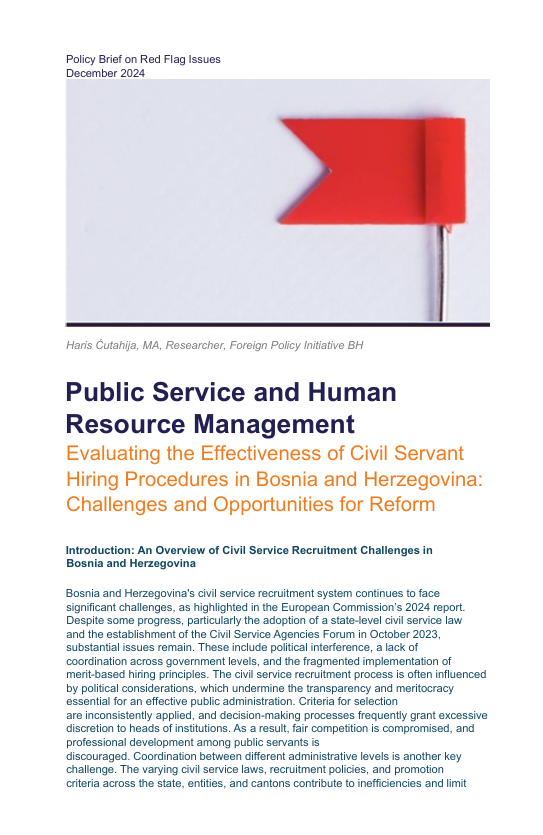
Public Service and Human Resource Management: Evaluating the Effectiveness of Civil Servant Hiring Procedures in Bosnia and Herzegovina: Challenges and Opportunities for Reform

Bosnia and Herzegovina’s civil service recruitment system continues to face significant challenges, as highlighted in the European Commission’s 2024 report. Despite some progress, particularly the adoption of a state-level civil service law and the establishment of the Civil Service Agencies Forum in October 2023, substantial issues remain. These include political interference, a lack of coordination across government levels, and the fragmented implementation of merit-based hiring principles. The civil service recruitment process is often influenced by political considerations, which undermine the transparency and meritocracy essential for an effective public administration. Criteria for selection are inconsistently applied, and decision-making processes frequently grant excessive discretion to heads of institutions. As a result, fair competition is compromised, and professional development among public servants is discouraged. Coordination between different administrative levels is another key challenge. The varying civil service laws, recruitment policies, and promotion criteria across the state, entities, and cantons contribute to inefficiencies and limit the mobility of civil servants. While the action plan for public administration reform (2023–2027) aims to address these discrepancies, its success hinges on sufficient budgetary support and political commitment.

Download the brief here.

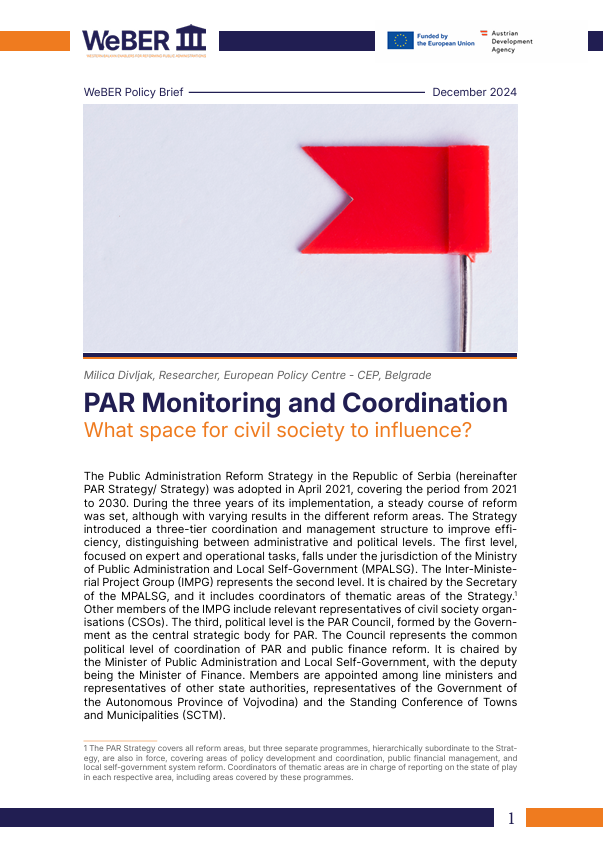
PAR Monitoring and Coordination: What space for civil society to influence?

The Public Administration Reform Strategy in the Republic of Serbia (hereinafter PAR Strategy/ Strategy) was adopted in April 2021, covering the period from 2021 to 2030. During the three years of its implementation, a steady course of reform was set, although with varying results in the different reform areas. The Strategy introduced a three-tier coordination and management structure to improve efficiency, distinguishing between administrative and political levels. The first level, focused on expert and operational tasks, falls under the jurisdiction of the Ministry of Public Administration and Local Self-Government (MPALSG). The Inter-Ministerial Project Group (IMPG) represents the second level. It is chaired by the Secretary of the MPALSG, and it includes coordinators of thematic areas of the Strategy. Other members of the IMPG include relevant representatives of civil society organisations (CSOs). The third, political level is the PAR Council, formed by the Government as the central strategic body for PAR. The Council represents the common political level of coordination of PAR and public finance reform. It is chaired by the Minister of Public Administration and Local Self-Government, with the deputy being the Minister of Finance. Members are appointed among line ministers and representatives of other state authorities, representatives of the Government of the Autonomous Province of Vojvodina) and the Standing Conference of Towns and Municipalities (SCTM).

Download ENG and SRB

National PAR Monitor 2021/2022 – Kosovo

The Kosovo PAR Monitor 2021/2022 is the result of monitoring work performed in 2021/2022 by the Group for Legal and Political Studies, and it represents findings from Kosovo in the six areas of PAR defined by the Principles of Public Administration (SIGMA principles). As the third systematic PAR monitoring done in Kosovo by GLPS, this report offers comparisons with the baseline PAR Monitor findings of the 2017/2018 and 2019/2020 monitoring cycles.

PAR Monitor reports are based on a comprehensive methodological framework designed by the WeBER research team that combines quantitative and qualitative sources of evidence. With the SIGMA principles as the building blocks of monitoring work, PAR Monitor reports are complementary to similar work by SIGMA/OECD and the European Commission, differing in that they offer citizen and civil society perspectives on these principles. Together with this comparative regional report, the PAR Monitor package consists of six national reports, each including findings on a total of 23 compound indicators to monitor a selection of SIGMA Principles.

The Kosovo PAR Monitor 2021/2022 is available for download here: English.

National PAR Monitor 2021/2022 – Montenegro

The Montenegro PAR Monitor 2021/2022 is the result of monitoring work performed in 2021/2022 by the Institut Alternativa, and it represents findings from Kosovo in the six areas of PAR defined by the Principles of Public Administration (SIGMA principles). As the third systematic PAR monitoring done in Montenegro by IA, this report offers comparisons with the baseline PAR Monitor findings of the 2017/2018 and 2019/2020 monitoring cycles.

PAR Monitor reports are based on a comprehensive methodological framework designed by the WeBER research team that combines quantitative and qualitative sources of evidence. With the SIGMA principles as the building blocks of monitoring work, PAR Monitor reports are complementary to similar work by SIGMA/OECD and the European Commission, differing in that they offer citizen and civil society perspectives on these principles. Together with this comparative regional report, the PAR Monitor package consists of six national reports, each including findings on a total of 23 compound indicators to monitor a selection of SIGMA Principles.

The Montenegro PAR Monitor 2021/2022 is available for download here: Montenegrin and English.